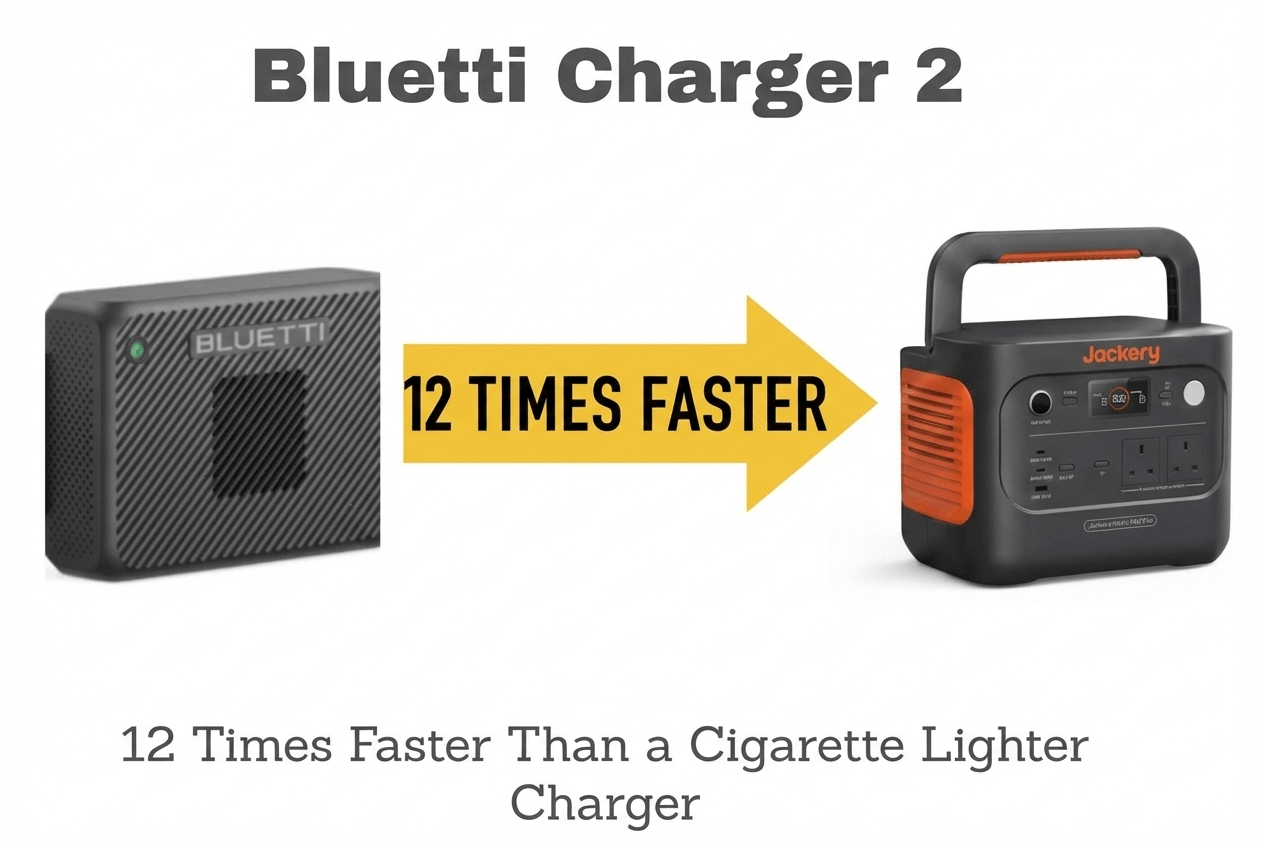
Bluetti launched the Bluetti Charger 2 at CES (Consumer Electronics Show) in Las Vegas, early January 2026.
The Bluetti Charger 2 offers some major improvements over its predecessor, providing greater versatility for those who rely on renewable energy sources while on the road.
It enables users to harness power from multiple sources, reducing reliance on a single energy source.
Van lifers have long needed two devices: a DC-DC charger that charges your battery pack while you drive, and an MPPT controller that extracts the maximum available power from solar panels.
The Charger 2 combines both solar and alternator functions into a single smart device. However, is it worth switching from the more affordable Charger 1?
1. The “Big Feature”: Dual Input Charging
The Charger 1 which we reviewed here, is great, but it only charges from your engine.
The Charger 2 stands out because it can use both solar and alternator power simultaneously, reducing charging times and enabling users to maximise energy use.
Alternator Input: Up to 800W
Solar Input: Between 400W to 640W
Combined Speed: Up to 1,200W
What this means for you:
On a sunny day, you can charge your Jackery 2000 Plus in about 2 hours while driving. That’s impressively fast for a van setup.

Bluetti Charger 2 At The 2026 CES Las Vegas Show
2. Intelligent “Traffic Control”
The Charger 2 efficiently manages power inputs.
While driving, it uses the alternator first and adds solar power if available.
When parked, it switches to solar mode and draws all charging power from the panels.
It allows reverse charging to the starter battery, which is useful if you leave the interior light switch on overnight and have a flat battery in the morning.
It detects when the engine is off and disconnects the alternator right away, so your starter battery stays protected.
3. Comparison:
Charger 1 vs Bluetti Charger 2.
If you’re already equipped with solar panels, the added benefit of the Charger 2 is that you won’t need to replace your existing setup; it integrates with it.
| Feature | Bluetti Charger 1 | Bluetti Charger 2 |
| Best For | Simple Van Builds / Part Timers | Full-Time Van Life / Heavy Power Users |
| Max Output | 560W | 1,200W (Combined) |
| Solar Input | No (Engine Only) | Yes (Built-in MPPT) |
| Price | -£220 | -£399 |
| Wiring | Simple (2 Wires) | More Advanced (4 Wires: Alt + Solar) |
Power Charging Comparison Between Charger 1 and Bluetti Charger 2
| Power Station | Charger 1 (560W) | Charger 2 (1,200W) |
|---|---|---|
| Jackery 2000 Plus (2 kWh) | ~4 Hours | ~1.8 Hours (accepts high input) |
| EcoFlow Delta 2 Max (2 kWh) | ~4 Hours | ~1.8 Hours |
| Bluetti AC200L (2 kWh) | ~4 Hours | ~1.8 Hours |
4. Who Should Buy It?
Stick with the Charger 1 if: You already have solar panels installed with their own controller.
You have a smaller power station (Jackery 1000 or smaller) that can’t handle 1,200W input anyway.
Upgrade to the Charger 2 if: You are building a van from scratch and haven’t bought a solar controller yet.
You have a large battery (2kWh+) and need the fastest possible charging speed.
You want a cleaner setup with fewer wires and boxes.
Verdict:
The Charger 2 is a powerful power management system designed as a premium choice for van electrical setups.

BLUETTI Charger 2
Limited Time Offer to 6th Feb
Only £349 Save–£300
4.7 Stars On Amazon
Apply the £300 Amazon voucher at checkout – Limited stock, terms apply.
Ensure you explore Bluetti’s official resources, as they provide invaluable guidance on installation and optimisation.
Watch Bluetti’s Official Install Video Here:

Q&A
Q: Is it safe for my vehicle’s alternator?
Yes, it draws ~66A from 12V systems. Most 100A+ alternators handle it fine with Bluetti’s built-in protections
Q: Is it safe for the vehicle starter battery?
Yes, smart disconnect when the engine stops, and low-voltage cut-off during running prevent power drain.
Q: Do I need to adjust Charger 2 for different power stations?
Yes, after you activate Charger 2, adjust the charging Voltage using the Bluetti app to match your power station’s specs.
If you haven’t already, check out our latest guide: How to Connect Solar Panels to Your Portable Power Station

