
This guide shows you how to safely connect cheaper rigid solar panels to Bluetti, EcoFlow, and Jackery portable power station solutions, avoid over-voltage damage, and choose the right adapter cables for solar panels portable power station.
By: Jonny Graham | Updated January 2026 | 15 min read
You’ve purchased a portable power station, such as a Bluetti, Jackery, or EcoFlow. Now you can make coffee and charge your laptop wherever you are. But there’s a problem: there is nowhere to recharge the power station battery.
To stay off-grid in the UK, you need to refill that battery tank daily. The most common question we get is: “Do I have to buy the expensive folding solar panels from the manufacturer?”
The short answer: No.
You can save hundreds of pounds by using standard rigid solar panels, like the ones used on houses, but only if you know how to connect them safely. If you get it wrong, you could damage your expensive unit.
This guide explains how to match solar panels to your portable power station, why “over-volting” is the biggest risk, and which adapter cables you actually need.
Understanding the connection between solar panels and portable power station is crucial for optimal performance.
Understanding the Basics: Watt-Hours vs. Amp-Hours
If you read older van-life forums, you’ll often see people talking about “Amp Hours.” Portable power stations, however, are rated in Watt-hours (Wh), so we’ll use Wh throughout this guide instead.
Think of your power station like a fuel tank:
- The Tank Size: A Bluetti AC200L has a capacity of roughly 2,000Wh
- The Goal: You need to put ~1,000Wh back into it every day to stay topped up
The UK Cloud Factor
In California, a 200W panel generates close to 200W on a sunny day.
In the UK, because of grey skies and a low sun angle, that same 200W panel might only produce 40W to 100W on a typical day. (This is the real-world average output, not the rated power.)
The Golden Rule: To recharge a medium-sized power station (1,000Wh capacity) in one British day, you need at least 300W-400W of solar panels.
A single 100W panel won’t be enough to run a fridge and a laptop in Scotland—or survive UK power cuts when you’re off-grid.”
Can You Use Rigid Solar Panels With Jackery, Bluetti, and EcoFlow?
Once you know how many panels you need, you might ask if fixed panels are an option.
Yes, and it is usually the best option.
Fixed rigid panels (glass front, aluminium frame) are cheaper and more durable than the “branded” folding panels sold by power station manufacturers.
Price Comparison:
- Folding Panel (200W): £400-£500
- Rigid Panel (200W): £150-£200
That’s a £250-£300 saving per 200W.
The Catch: They Have Different Connectors
Rigid panels use MC4 connectors, which are the waterproof black clips, but your power station has its own input port, such as an XT60 or DC7909. You can’t connect them directly.
You’ll need an adapter cable to connect the MC4 connectors on the rigid panel to your power station’s input, such as an XT60 or DC7909. Make sure the adapter fits both kinds and can handle the right current and voltage for safe use.
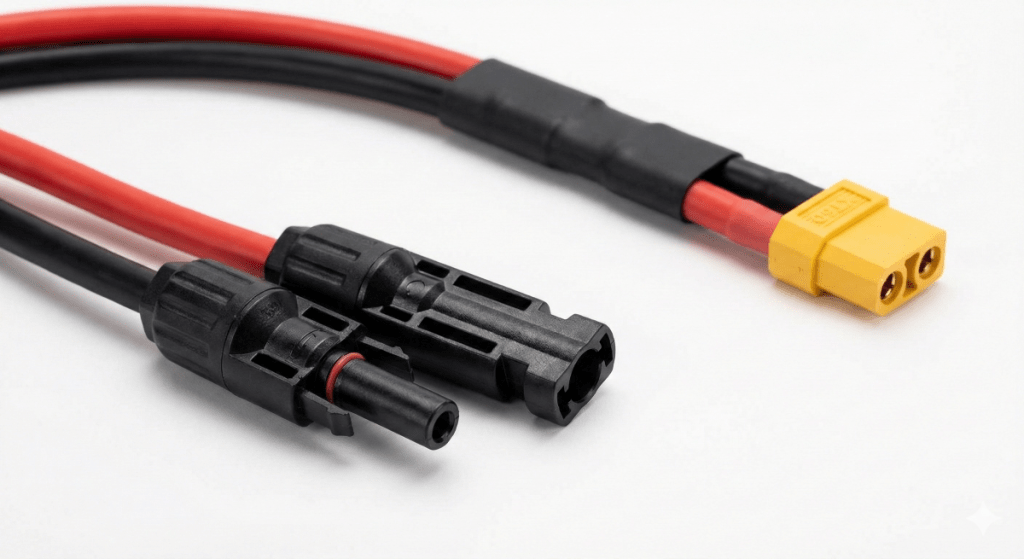
Diagram 1: Connector Types – Visual Reference
MC4 Connectors
Standard on rigid solar panels
Waterproof, locking design
XT60 Connector
Bluetti, EcoFlow, Anker
Yellow body, high current
DC7909 Barrel Jack
Jackery, Goal Zero
8mm round plug
Anderson PowerPole
Goal Zero (some models)
Red/black modular
Panel Type Comparison: What Works Best?
1. Rigid (Glass & Frame) Panels
Pros:
- Cheapest option (£0.60-£0.75 per Watt)
- Most durable (20+ year lifespan)
- Great value if you plan to stay in the van for an extended period.
- Excellent heat management with an air gap for air flow
Cons:
- Heavy and bulky
- Not portable (unless you build a ground stand)
- Require adapter cables
Verdict: Best value for van roofs and semi-permanent setups
2. Branded Folding Panels (Bluetti, EcoFlow, Jackery)
Pros:
- Plug-and-play (no adapters needed)
- Portable and easy to set up
- They are supplied with a carrying case
- Can be angled towards the sun
Cons:
- Expensive (£2-£2.50 per Watt)
- Fabric hinges can wear out
- Less efficient than rigid panels
Verdict: Good for portability, but overpriced for permanent use
3. Generic Folding Panels (Amazon/eBay)
Pros:
- Cheaper than branded versions (£1-£1.50 per Watt)
- Portable
- Usually supplied with multiple output options
Cons:
- Quality varies by quite a lot
- Shorter warranty periods
Verdict: Budget-friendly middle ground for occasional use
The Missing Link: Adapter Cables Explained
To make rigid panels work with your power station, you need an adapter cable. This is the single most important component in your setup.
Common Adapter Types:
| Power Station Brand | Input Port Type | Required Adapter |
|---|---|---|
| Bluetti (most models) | XT60 or Aviation Plug | MC4 to XT60 |
| EcoFlow Delta series | XT60 or MC4 (newer models) | MC4 to XT60 |
| Jackery (most models) | DC7909 (8mm barrel) | MC4 to DC7909 |
| Anker SOLIX | XT60 | MC4 to XT60 |
| Goal Zero | 8mm Anderson or APP | MC4 to Anderson |
*Aviation Plug used on older Bluetti models only; most current models use XT60
Money-Saving Tip: You don’t have to buy the brand’s official cable. Good-quality 10 AWG solar adapters cost £15- £25 on Amazon. Check your power station’s manual to confirm which input port it uses.
What to look for in an adapter:
- Wire gauge: Minimum 10AWG (use thicker cable for longer runs)
- Weatherproofing: IP67 rated for use outdoors
- Length: 1-2m is sufficient
Voltage Limits (VOC)
This section is critical. Incorrect voltage could damage your power station.
Check your power station’s Maximum Solar Input Voltage in the specs (‘Solar Input’).
Examples:
- Bluetti EB3A: 28V max
- EcoFlow Delta 2: 60V max
- Bluetti AC200L: 145V max
- Jackery Explorer 1000 v2: 35V max
Solar panels have a rating called VOC (Voltage Open Circuit), the maximum voltage the panel can produce, usually in cold, bright conditions.
Total VOC of your panels MUST NEVER exceed the Input Limit of your power station.
Important Note: VOC varies by manufacturer. Always check your specific panel’s datasheet. Typical range: 21-24V for 100W panels, 40-48V for 200W panels.
Voltage Limits – Safe vs. Dangerous Scenarios
Understanding VOC (Voltage Open Circuit) and Maximum Input Limits
✓ SAFE SCENARIO
Single Panel Setup
Max Input: 60V
Panel: 1× 200W Rigid
VOC: 24V
Total VOC: 24V < 60V ✓
✓ SAFE SCENARIO
Parallel Wiring
Max Input: 35V
Panels: 2× 100W (Parallel)
VOC: 22V each
Total VOC: 22V < 35V ✓
(Voltage stays the same in parallel)
✗ DANGEROUS!
Over-Voltage Risk
Max Input: 28V
Panels: 2× 100W (Series)
VOC: 24.3V each
Total VOC: 48.6V > 28V ✗
(24.3V + 24.3V = 48.6V in series)
✗ DANGEROUS!
Cold Weather Spike
Max Input: 30V
Panel: 1× 200W Rigid
VOC: 24V (rated)
Cold Spike: +15% = 27.6V
Warning: Very close to the limit!
(Leave 10% safety margin)
Always use VOC (Open Circuit Voltage) for calculations, not VMP (Maximum Power Voltage). VOC levels are 15-20% higher and represent worst-case conditions. In cold weather, VOC can spike even higher, so always leave a 10% safety margin below your power station’s maximum input voltage.
✅ How to Check Solar Panels Are Safe (4 Steps)
Follow these 4 steps to avoid over-voltage damage:
- Step 1: Find your power station’s max solar input voltage (e.g. Bluetti EB3A = 28V, EcoFlow Delta 2 = 60V, Jackery 1000 v2 = 35V)
- Step 2: Check each solar panel’s VOC (Open Circuit Voltage) from the datasheet (typically 21-24V for 100W panels)
- Step 3: Series wiring adds VOCs (2 × 22V panels = 44V total). Parallel keeps VOC same (2 × 22V panels = 22V total)
- Step 4: Total VOC must be 10% below max input (28V limit → max 25.2V panels)
Quick examples:
1× 200W (24V) on Delta 2 (60V) = Safe
2× 100W series (48.6V) on EB3A (28V) = Danger
2× 100W parallel (22V) on Jackery 1000 v2 (35V) = Safe
Voltage Examples Summary
Example 1: Single 200W Panel on EcoFlow Delta 2 (Safe)
Power Station: EcoFlow Delta 2 (60V max input)
Panel: 1 × 200W rigid (VOC: 24V)
Total VOC: 24V < 60V ✓ Safe to connect
Example 2: Two 100W Panels in Parallel on Jackery 1000 v2 (Safe)
Power Station: Jackery 1000 v2 (35V max input)
Panels: 2 × 100W (parallel wiring)
Total VOC: 22V same (parallel wiring) < 35V ✓ Safe
Example 3: Two 100W Panels in Series on Bluetti EB3A (Dangerous)
Power Station: Bluetti EB3A (28V max input)
Panels: 2 × 100W (series wiring)
Total VOC: 48.6V (24.3V + 24.3V) > 28V ✗ Likely to damage unit or void warranty
Example 4: Single 200W Panel on Jackery 500 (Caution)
Power Station: Jackery 500 (30V max input)
Panel: 1 × 200W rigid (VOC: 24V)
Cold weather spike: ~27.6V → Very close to limit ⚠️ Use with caution, monitor closely
Wiring: Series vs. Parallel Explained
If you have two or more panels, how you wire them changes the voltage. This is how to stay safe and improve performance.
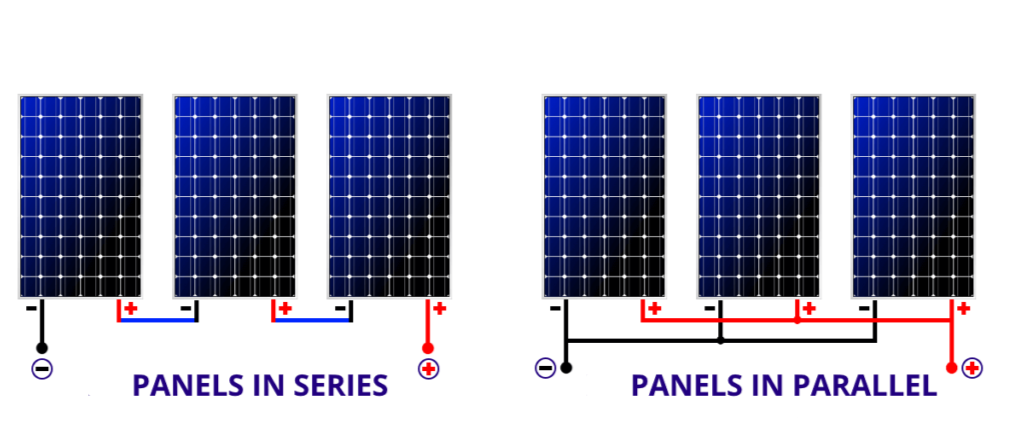
Examples Of Wiring Layout For Series and Parallel Solar Panels
Notes For: Series Wiring System:
Suitable for larger power stations with high-voltage limits of 60V Plus.
Better for the UK winter, it starts charging earlier.
Simpler wiring (no Y-branches needed)
Longer ”solar day” in low light.
Not suitable for smaller units (can exceed voltage)
Shaded light on one panel affects the performance of the other panels.
Notes For: Parallel Wiring System:
Suitable for small Power Stations with low voltage limits <50V
If one panel gets shaded, the others will still work independently.
It’s the safer option for beginners.
One downside is that the lower voltage may find it difficult in poor lighting conditions.
Requires Y-branch connectors (at extra cost)
Quick Reference: Series vs Parallel For 3 Panels Wired Together
| Configuration | Voltage | Current | Best For |
|---|---|---|---|
| Series | Triples vs 1 Panel | Stays the same as 1 Panel | Large power stations (100V+ limit) Cold UK winter. Fewer cables |
| Parallel | Stays the same as 1 Panel | Triples vs 1 Panel | Small power stations. Shade tolerance. Safer when voltage limits are low. |
What You Need:
- For Parallel: MC4 Y-branch connectors (£8-£12 per pair)
- For Series: Standard MC4 extension cables (panels daisy-chain together)
The Best Setup for Your UK Campervan Power Station
To help you decide, here are example setups for different user requirements. Choose based on your power demands.
How Much Solar Do You Need for Van Life in the UK ?
The Weekender” (Small Power Station)
Units: Jackery Explorer 500 / Bluetti EB3A / Anker 521
Battery Capacity: 300-500Wh
Recommended Solar: 100W Portable Folding Panel
Why: These small units have low voltage limits (28-35V). Using a single branded folding panel or one small rigid panel is the safest and easiest option. The price difference isn’t big at this size.
Estimated Cost: £300-£450 (Power Station + Solar Panel)
The “Van Lifer” (Medium Power Station)
Units: EcoFlow Delta 2 / Bluetti AC180 / Jackery Explorer 1000
Battery Capacity: 1,000-1,500Wh
Recommended Solar: 300W-400W Rigid Panels (2× 175W or 2× 200W)
Setup:
- Mounted on the van roof or portable ground stands
- Wired in series (if voltage limit allows) or parallel (if limit is low)
- Connected via MC4 to XT60 adapter
Why: This setup gives you strong charging power for much less money than branded folding panels. It’s perfect for full-time van life.
Estimated Cost: £800-£1,400 (Power Station) + £300-£400 (solar panels & cables)
The “Off-Grid Pro” (Large Power Station)
Units: Bluetti AC200L / EcoFlow Delta Pro / Anker SOLIX F2000
Battery Capacity: 2,000-3,600Wh
Recommended Solar: 600W-1,000W Rigid Panels (3-5× 200W panels)
Setup:
Use up as much roof space as possible.
The units can handle high voltage (up to 150V)
Wire three panels in series to catch as much winter sun as possible.
Consider adding expansion batteries to go with the power station.
Why: This is for off-grid users who want to run everything, including induction hobs, washing machines, and power tools.
Estimated Cost: £1,500-£3,500 (Power Station) plus £500 to £800 (Solar Panel System)
Real World Examples
1. The Weekend Camper
- Power Station: Jackery Explorer 500 (518Wh)
- Solar: 1 × Jackery 100W folding panel
- Daily Generation: 200-400Wh (summer) 50-150Wh (winter)
- What it runs: Lights, phone charging and a small 12V fridge
- Total Cost: ~£550
2. The Full-Time Van Lifer
Power Station: EcoFlow Delta 2 (1kWh)
Solar Power: 2 off 200W solid panels with in-series wiring
Adapter: MC4 to XT60
Daily Power Generation: 600 – 1,200Wh in summer, 200-500Wh during winter
What it runs: Fridge, Laptop, Lights, Diesel Heater, plus Starlink
Total Cost: £1,200 – £1,500 power station + £300 solar setup It’s perfect for full-time van life.
3: The Off-Grid Professional
Power Station: Bluetti AC200L 2,048Wh + B300 expansion 3,072Wh
Solar: 4× 200W rigid panels – series wiring = 800W
Adapter: MC4 to Aviation Plug or XT60 on newer models.
Daily Generation: 1,200-2,400Wh during summer, 400-1,000Wh in winter.
Runs the following: Everything from above, plus induction hob, washing machine, and power tools.
Total Cost: (£3,200) £2,500 power station and batteries plus £700 for solar.
From solar panels to a charging power station: the complete connection flow:

Before Connecting:
Verify VOC < Max Input Voltage.
Check that the adapter matches your unit.
Start in the shade, then move to sun.
Troubleshooting:
Display shows 0W? Check the connections
Error code? The Voltage may be too high.
Low wattage? Clean the panels or reposition them.
Success Indicators:
Solar icon is active on the display.
Wattage matches the sunlight conditions.
Battery % is rising steadily.
Setup Checklist Before Purchase:
- Check your power station’s maximum solar input voltage and connector type.
- Choose the panels with a total VOC below your power station’s limit.
- Choose series or parallel wiring based on your power station’s voltage limits.
During Installation :
4. Connect the panels in your chosen layout, either in series or parallel.
5. Attach the correct MC4 to XT60/DC7909/Anderson adapter cable.
6. Connect the cables in a shaded area to avoid voltage spikes.
7. Plug into the power station and check the display.
8. Move to sunlight and monitor for the first 30 minutes.
Verification:
9. Display shows solar input at 100W+
10. Battery percentage is steadily rising.
11. No error codes visible.
12. Estimated charge time displayed.
Safety Checklist
Never exceed your power station’s maximum input voltage
Always check the panel VOC ratings before connecting
Use proper gauge cables (minimum 10AWG for solar)
Protect connectors from moisture and dirt
Don’t mix different panel types or wattages
Start in the shade when first connecting panels
Monitor charging for the first hour
Leave 10% safety margin below the maximum voltage limit
Common Mistakes to Avoid
Mistake 1: Ignoring the VOC Ratings
The Problem: Using VMP operating voltage instead of VOC can cause overvoltage damage in cold weather.
The Fix: Always use VOC for calculations—it’s the worst-case scenario number.
Mistake 2: Cheap, Thin Cables
The Problem: Thin cables cause voltage drop, meaning power is lost as heat before reaching your battery.
The Fix: Use a minimum of 10AWG cables. For runs over 5 meters, use 8 AWG.
Mistake 3: Mixing Panel Sizes
The Problem: Connecting a 100W and a 200W panel together drags the 200W panel down to match the weaker one.
The Fix: Use identical panels wherever possible.
Mistake 4: Series Wiring on Low-Voltage Units
The Problem: Small power stations like the EB3A (28V limit) can’t handle two panels in series (48V total VOC).
The Fix: Use parallel wiring or stick to a single panel.
Recommended Gear: The Best Rigid Solar Panels on Amazon
We’ve tested and researched the market to save you the scrolling. If you’re building a system for a portable power station, these are the two panels we recommend.
1. The “Gold Standard”: Renogy 100W Monocrystalline
If you want a panel you can install and not worry about for the next 10 years, this is the one. Renogy is known as the “Apple” of the DIY solar world: reliable, efficient, and a bit more expensive.
Best For: Serious van lifers (Tier 2 & 3 setups)
Why We Like It: It uses high-purity monocrystalline cells that perform better in bad lighting conditions in the UK. The frame is made of corrosion-resistant aluminium, so it won’t rust even after five Scottish winters.
The Verdict: If you can afford the extra £20, buy this one. It pairs perfectly with high-end units like the Bluetti AC200L or EcoFlow Delta 2.
Key Specs:
- Power Output: 100W
- VOC: 22.5V (safe for most power stations)
- Efficiency: 21%+
- Warranty: 25-year power output guarantee
Check Price on Amazon (Renogy 100W)
2. The “Budget Friendly”: Eco-Worthy 100W Monocrystalline
Building a van on a tight budget? Eco-Worthy is the answer. It’s one of the most popular panels in the UK for a reason: it does the job for a fraction of the price.
Best For: Weekend campers and budget builds (Tier 1 setups)
Why We Like It: You can often buy two of these for the price of one branded folding panel. The frame is a bit lighter than the Renogy, but the power output is still very good.
The Verdict: The smartest way to get started. You could mount two of these (200W total) for less than £150. Ideal for the Jackery 500 or Bluetti EB3A.
Key Specs:
- Power Output: 100W
- VOC: 21.6V (safe for small power stations)
- Efficiency: 20%+
- Warranty: 1-year manufacturer warranty
Check Price on Amazon (Eco-Worthy 100W)
Essential Accessories You’ll Need
Don’t forget these important components to complete your setup:
MC4 to XT60 Adapter Cable (10AWG)
- For: Bluetti, EcoFlow, Anker power stations
- Check Price On Amazon
MC4 to DC7909 Adapter Cable
- For: Jackery power stations
- Check Price On Amazon
MC4 Y-Branch Connectors (Parallel Wiring)
- Essential for connecting multiple panels in parallel
- Check Price On Amazon
MC4 Extension Cables (5m)
- For positioning panels away from your van
- Check Price On Amazon
Frequently Asked Questions
Q: Do solar panels work for portable power stations in the UK winter?
Yes, but they produce less power. On cloudy December days, expect only 10-20% of the rated capacity. That’s why it’s important to install more wattage than you think you’ll need for year-round use.
Q: Can I mix different brands of solar panels?
It’s not recommended. Different brands have different VOC and VMP ratings. Mixing them in series means the whole system only works as well as the weakest panel, so you lose potential power.
Q: How do I know if my power station is charging?
Most modern power stations have a display showing:
- Solar input wattage (e.g., “Solar: 245W”)
- Estimated time to full charge
- Battery percentage
If the display shows “0W” in sunlight, check your connections and voltage compatibility.
Q: Do I need to clean my solar panels?
Yes. In the UK, moss, algae, and road dirt can build up fast. A dirty panel can lose up to 30% of its efficiency. Wipe it with a damp cloth every few weeks to keep it working well.
Q: What’s the break-even point for buying rigid panels vs. folding panels?
For a 400W system, you can save about £400-£600 by choosing rigid panels instead of branded folding panels. If you camp more than 20 nights a year, rigid panels will pay for themselves in the first season.
The Verdict: Is It Worth Buying Rigid Panels?
For small power stations (under 500Wh): Stick with branded folding panels. For medium- or large-power stations (1,000 Wh or more), you should buy rigid panels. You’ll save hundreds of pounds and get better long-term dependability.
Your break-even point is about 20-30 nights of camping. After that, you’ll have saved enough compared to using campsite hook-ups or always buying branded panels.
What Next?
Now that you’ve sorted out your charging, what can you power? Take a look at our guide the Best 12V Compressor Fridges for Campervans to see how efficient modern coolers are.

