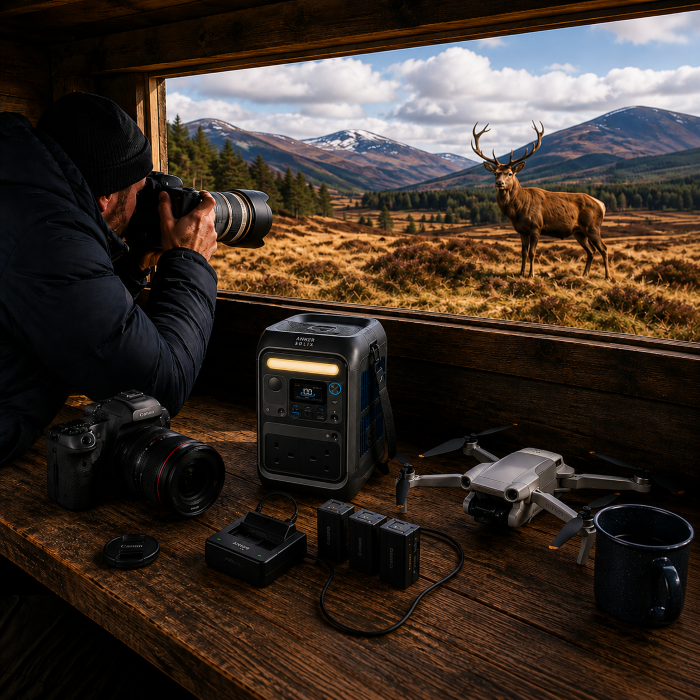
Anker Solix C300X Review UK: The Best Power Station For Off-Grid Photography?
By: Jonny Graham | Updated August 2026 | 9 min read
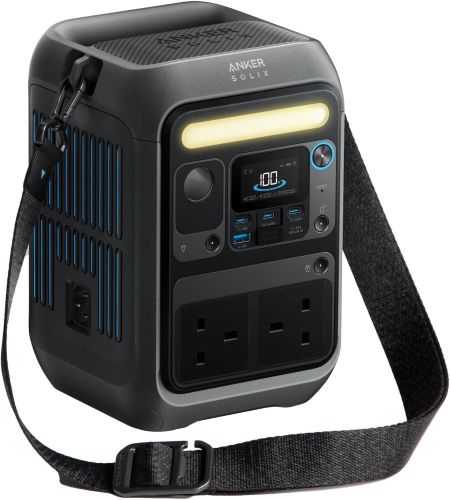
If you often work off-grid in remote areas with limited power and depend on your electronics, the Anker Solix C300X is made for you. It uses the same 288Wh LiFePO4 battery and 300W AC inverter as the standard C300, but the ‘X’ version adds a fast 10ms UPS switchover and advanced Wi-Fi app controls.

🏆 Quick Verdict
Rating: 4.7 out of 5 stars
If you are in the market for a portable battery to keep your laptop running in the field or to back up your home router during outages, this is one of the better options.
Off-Grid Photography & Remote Work
When using the C300X for a weekend trip focused on remote work and photography. The specs are impressive, but what really matters is whether the 288Wh battery can handle a busy digital workload for a few days away from AC power.
Skipping the big camping appliances and focusing only on tech gear here’s how the C300X performs.
- High-Power Laptops: The best feature is the two 140W USB-C PD ports. You can charge your devices without turning on the 230V AC inverter. When plugging a MacBook Pro straight into the USB-C port you get 3 to 4 full charges at top speed, with no energy loss as you get from a wall plug.
- Camera Batteries & Drones: A typical mirrorless camera battery has about 16Wh of power. The C300X manages 15 to 16 recharges over a weekend, so you can keep two cameras and a DJI drone powered up the whole time.
- Optional Compressor Fridge: A 12V compressor fridge drawing an average of 12W to 15W will run for 18 to 22 hours continuously on this 288Wh battery.
Anker Solix C300X Photography Off-Grid Runtime Table
| 12V Compressor Fridge Overnight | 12–15 W | 12–14 hours | 144–210 Wh |
| Laptop charging (MacBook Pro via 140W USB-C) | — | 1 full charge | 50–60 Wh |
| Camera Batteries (4 × ≈16 Wh) | — | 4 full recharges | 64 Wh |
| Total estimated consumption | — | — | ≈ 260–335 Wh |
⏱️ Anker SOLIX C300X Run-Time Calculator
Enter the wattage of the appliance you want to run to see exactly how long the 288Wh Anker SOLIX C300X will power it.
*Calculation includes a standard 15% AC inverter efficiency loss for real-world accuracy based on the 288Wh base capacity.
Will 288Wh cover recharging your camera gear and laptops? Try our UK Camping Power Calculator to figure out your daily power needs and see if the Solix C300X is right for your setup.
The Solar Setup: Navigating the 100W Bottleneck

To keep laptops and photography equipment running off-grid, you need to recharge the 288Wh battery every day. Like the standard model, the Anker Solix C300X limits solar input to 100W.
A 100W solar panel can recharge your battery during the day, even if you are only away for one night.
| Saturday morning–afternoon | 200–350 Wh | Enough to fully recharge the C300X |
| Full day (if staying longer) | 300–400 Wh | Comfortable top-up |
These are our recommended 100W solar panels for a remote working rig:
- The Premium Option: The official Anker 100W Portable Solar Panel is very efficient, folds up small with your camera gear, and connects straight to the power station.
- The Budget Alternative: The Renogy 100W Portable Folding Panel works great in sunny UK weather.
- Since third-party panels use MC4 connectors, you’ll need an MC4-to-XT60 adapter cable to connect it to the Anker unit.
(Do not guess with adapter cables. Use our free Solar Panel Matcher to find the exact panels and wiring you need for the Solix C300X.)
Honest Drawbacks: What the C300X Cannot Run
With a 300W continuous output and a 600W surge limit, this inverter is made just for charging tech and running small 12V devices. It is not meant for powering a campervan kitchen.
If you try to plug in a standard travel kettle, a small microwave, or a hair dryer, the inverter will instantly trip and shut down to protect itself. You will need to stick to your camping gas stove for brewing coffee and reserve the C300X purely for your digital workflow.
The tall, vertical design saves floor space but also makes it top-heavy. If you set it on uneven ground and catch a charging cable with your foot, it can tip over easily.
The Pros & Cons of the Anker Solix C300X
Pros:
- Lightning-Fast UPS: The under-10ms switchover is a big plus for remote workers. It acts as a safety net for your home router and desktop monitor during sudden power cuts.
- Dual 140W USB-C Ports: You can charge two powerful laptops at once.
- App Connectivity: With built-in Wi-Fi and Bluetooth, you can check the exact input and output wattage on your phone. This is really helpful when you want to get the most from your solar panels.
- Space-Saving Footprint: The tall, vertical shape takes up very little desk or floor space, whether you’re at home or travelling.
Cons:
- Strict 300W AC Limit: The inverter cannot power heating devices. You can only use it to charge tech and run small 12V appliances.
- Top-Heavy Build: The vertical design saves space, but the higher centre of gravity means it can tip over easily if it’s on uneven ground or if a charging cable gets pulled. Here is the exact technical breakdown of what is inside the C300X model:
Anker Solix C300X Technical Specifications:
| Feature | Specification |
| Battery Capacity | 288Wh |
| Battery Chemistry | LiFePO4 (3,000+ cycles to 80%) |
| AC Output | 300W Continuous (600W Surge) |
| AC Outlets (UK) | 2 x 230V 3-pin UK Sockets |
| Max Solar Input | 100W (11-28V) |
| AC Recharge Time | 70 Minutes (0-100%) |
| Weight & Dimensions | 4.13 kg (9.1 lbs) 16.4 × 16.1 × 24.0 cm (6.5 × 6.3 × 9.5 inches) |
| USB & DC Ports | 2x 140W USB-C, 1x 15W USB-C, 1x 12W USB-A, 1x 12V Car Socket |
| UPS Switchover | <10ms (Uninterruptible Power Supply) |
Anker Solix C300X vs Anker Solix C300 DC
The Anker Solix C300X and the Anker Solix C300 DC (which we reviewed earlier) share the same 288Wh LiFePO4 battery, but they serve different priorities.
The Anker Solix C300X includes full AC output (300W continuous / 600W surge) with two UK 3-pin sockets, plus a fast UPS switchover of under 10ms.
It weighs 4.13 kg and is better suited for running small 230V appliances or for reliable backup power for a home office or photography setup.
The Anker Solix C300 DC is the lighter, more portable option at just 2.8 kg. It has no AC outlets, focusing instead on strong USB-C and 12V DC output.
This makes it ideal for overnight fishing, camping, or any situation where weight and compact size matter more than powering mains appliances.
Choose the Anker Solix C300X if:
You need a proper 230V socket, UPS backup, or plan to run small AC appliances.
Pick the Anker Solix C300 DC if:
You want the lightest unit and just need to charge phones, laptops, 12V fridges, and other USB/DC devices.
Final Thoughts
If you are a photographer who needs to keep laptops and cameras running off-grid, and you want a reliable UPS backup for your home office, the Anker Solix C300X is one of the best compact options available on the market today.
Anker Solix C300X FAQ
What size of power station do I need? Is the Anker Solix C300X right for me?
The Anker Solix C300X (288Wh) is designed to charge laptops, camera batteries, drone batteries and as a back up for your home office. If you want to use heating appliances or a kettle, you’ll need something bigger. Use our free Camping Power Calculator to find the best fit for your needs.
Can the Anker Solix C300X run a microwave or kettle?
No. The AC output is limited to 300W. Travel kettles and microwaves need at least 600W to 1000W, so they will trip the inverter right away.
How fast is the UPS feature on the Anker Solix C300X?
The C300X switches over in less than 10 milliseconds. This is quick enough to keep desktop computers, medical devices, and Wi-Fi routers running without losing connection during a power cut.
What is the maximum solar input for the Anker Solix C300X?
The unit takes up to 100W of solar input and works within an 11V to 28V range.
Can I use third-party solar panels like Renogy with this Anker power station?
Yes, you can, as long as the Open Circuit Voltage (VOC) is under 28V. You’ll need an MC4-to-XT60 adapter cable to connect standard panels to the front port.

