Affiliate Disclosure: This page contains affiliate links. If you make a purchase through them, we may earn a small commission at no extra cost to you. See our affiliate disclosure page.
The “No-Trench” Revolution
Building a garden office should give you a quiet, focused place to work away from the noise at home.
You choose a timber cabin, add insulation, set up your desk, and then face the biggest challenge: getting power to your garden.
If you have ever asked an electrician for a quote to run mains power to your garden, you probably found the price surprisingly high.
The traditional method of powering a garden room is rarely simple. It typically involves:
Paying £1,000 to £3,000 (or more) for a professional installation.
Hiring an excavator or spending days breaking your back digging a 600mm deep trench across your perfectly manicured lawn.
Drilling through the exterior walls of your home to connect the sub-main to your primary consumer unit.
Waiting weeks for an available tradesperson to complete the work and sign off on the required building control certificates.
The whole process is messy, costly, and stressful. It can blow your budget and leave your garden looking like a building site.
Welcome to the Plug-and-Play Era
Luckily, you no longer have to rely on the national grid for your workday power.
In recent years, battery technology has improved a lot. Old, heavy lead-acid batteries are now replaced by modern, safe LiFePO4 (Lithium Iron Phosphate) portable power stations.
These units are quiet, fume-free, and safe to use indoors. They fit neatly under your desk and have standard UK sockets on the front. You can charge them with solar panels on your shed roof or just bring the unit inside to recharge from a wall plug during the darkest winter days.
With an off-grid setup, you control your workspace. There are no trenches, no need for electricians, and no hidden fees. Just unbox your power station, plug in your laptop and Wi-Fi, and start working.
Calculating Your 9-to-5 Power Draw
Many people picture off-grid buildings with huge battery banks and lots of wiring. The truth is, modern remote work equipment uses very little energy.
Unless you are using heavy machinery or mining cryptocurrency, your daily power needs are probably much lower than you expect.
To show how practical an off-grid office can be, let’s do the maths. Portable power stations are measured in Watt-hours (Wh). To find out what you need, add up the wattage of your devices and multiply by your working hours.
Here is the typical power draw for a modern home office setup:
Laptop (e.g., MacBook Pro or Dell XPS): ~50W to keep it charged while working.
External Monitor (27-inch LED): ~30W each (Let’s assume two monitors for a total of 60W).
Wi-Fi Router or 4G/5G Hub: ~15W.
LED Desk Lamp: ~10W.
Phone Charger: ~5W. Total continuous power use: about 140 Watts.
The 8-Hour Workday Reality Check
If you use 140W for an 8-hour workday, (8 x 140 = 1,120) the calculation is 1,120Watt-hours (Wh) per day. That’s all you need. About 1.1 kWh of power is enough for a full day of work without interruptions.
What happens if you only work in the garden for a few hours at a time, or you only use a laptop without external monitors? Your power needs drop even further, often down to just 500Wh to 600Wh per day.
When you know what your office setup needs, choosing the right power station is easy. You do not have to guess or spend extra on a huge unit you will not use fully.
Crunch Your Own Numbers
Now that we know the baseline draw of a standard home office setup, it is time to calculate the exact requirements for your specific build.
We have built this interactive **Garden Office Power Calculator** to completely remove the guesswork from sizing your off-grid setup. Simply adjust the daily hours for the tech you plan to use, select the season you intend to work through, and the tool will instantly reveal the exact minimum battery capacity and solar panel wattage you need to prevent mid-afternoon blackouts.
*Enter your hours below to find your perfect power station size:*
Garden Office Power Calculator
Simply enter your typical **uses**, **boils**, or **hours of runtime** for your office equipment below. We'll automatically determine your perfect off-grid power setup for working from the bottom of the garden.
Swipe table to view totals ➔
Icon
Appliance
Avg. Watts
Daily Usage
Total (Wh)
Office Equipment & Tech
Laptop (MacBook Pro / Dell)
50W
hrs
0 Wh
External Monitor
30W
hrs
0 Wh
WiFi Router & Modem
15W
hrs
0 Wh
Inkjet Printer (Assumes 5 mins/use)
30W
uses
0 Wh
Laser Printer (Assumes 5 mins/use - High Surge)
800W
uses
0 Wh
Tablet Trickle Charge
30W
hrs
0 Wh
Phone Charger
5W
hrs
0 Wh
Tech Subtotal:
0 Wh
Lighting & Climate Control
LED Desk Lamp
5W
hrs
0 Wh
Heated Desk Pad
30W
hrs
0 Wh
Heated Blanket / Throw
50W
hrs
0 Wh
Small Space Heater (High Draw!)
500W
hrs
0 Wh
Desk Fan
20W
hrs
0 Wh
Diesel Heater (Fan & Pump draw only)
25W
hrs
0 Wh
Climate Subtotal:
0 Wh
Optional Comfort Items
Mini Fridge
40W
hrs
0 Wh
Coffee Maker (Assumes 5 mins/use)
600W
uses
0 Wh
Small Kettle (Assumes 5 mins/boil)
600W
boils
0 Wh
Comfort Subtotal:
0 Wh
RESULTS BOX
Daily Raw Power Needed: 0 Wh
Recommended Station Size: 0 Wh Class
*Calculation includes a 15% buffer to account for common 240V AC inverter efficiency loss (the standard difference between battery capacity and usable output for standard plug sockets).
RECOMMENDED POWER STATIONS (STEP 2)
Based on your daily office calculation above, we recommend these top choices:
Since we learned that an average 8-hour workday uses about 1.1 kWh, the main question is: how many days a week do you work in your garden office?
If you only use your garden office a couple of days a week, you need a different setup than someone working there full-time.
Here are the best indoor-safe LiFePO4 power stations in the UK, matched to different work routines.
Tier 1: The Part-Timer (1 to 2 Days a Week)
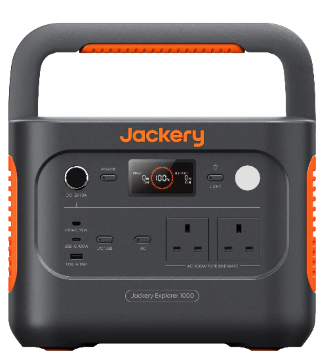
If you need off-grid power just a few days a week, a 1,000 Watt-hour (1 kWh) unit is ideal. It will last for an 8-hour shift, and you can easily bring it inside to recharge on your days off.
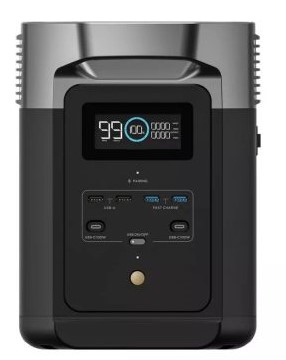
Our Top Pick: EcoFlow Delta 2 (1,024Wh)
The EcoFlow Delta 2 is widely considered the gold standard for mid-sized power stations, and it is our ultimate recommendation for a home office.
Future-Proof Expandability: This is the main advantage. If you later want to work from the garden more often, just buy a Delta 2 Extra Battery, plug it in, and double your capacity.
Lightning-Fast Recharging: In the dark UK winters, you may need to charge the unit indoors. The Delta 2’s X-Stream fast charging goes from 0% to 80% in just 50 minutes. Plug it in during lunch, and you will have a full battery for the week.
If your garden office is your full-time workspace, a 1 kWh battery is not enough. For a 5-day workweek, you need a 2,000-watt-hour (2 kWh) battery to get through cloudy days without always carrying it inside to recharge.
Our Top Pick: EcoFlow Delta 2 Max (2,048Wh)
If you spend 40 hours a week in your garden office, the EcoFlow Delta 2 Max has a big advantage that is often overlooked: it is very quiet.
Whisper-Quiet Operation: When running typical office equipment (about 150W), the Delta 2 Max is very quiet. You will not hear loud fans or background noise during your important Zoom calls.
Massive Safety Net: With more than 2,000Wh of capacity, a laptop, router, and monitor can run for almost two full workdays before you need to recharge.
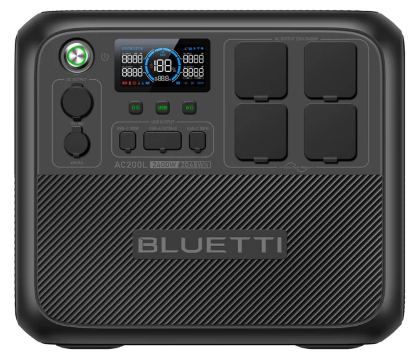
If you want to install solar panels on your shed roof for year-round off-grid power, plus a 12v diesel heater for cold winter days we recommend the Bluetti AC200L. It is our top pick for a reliable garden office solar setup.
Exceptional Solar Input: The AC200L can handle a massive 1,200W of solar input. You can install two or three large solar panels on your office roof. Even on short, cloudy winter days, its advanced MPPT controller captures and stores sunlight more efficiently than most portable units. For garden maintenance, the AC200L’s 2,400W pure sine-wave inverter handles garden electrical power tools effortlessly.
Once you have decided on which power station you will be using check out our solar panel calculator just choose your power station from the drop down list and the calculator will provide a list of the recommended solar panels and accessories needed to get your off-grid solar system up and running stress free.
If you browse through social media, you will see van-lifers and off-grid builders parked under blazing sun. If you look at social media, you will see people in sunny places like California saying their solar panels give them free power year-round. Solar panels on the roof of your garden office are a brilliant investment, but you have to understand the difference between the “Summer Dream” and the “Winter Slump” to keep your business running smoothly.
The Summer Dream (April to September)
During the British summer, solar power feels like magic. In the British summer, solar power works really well. In June, the sun is up for over 16 hours a day. With 400W of solar panels on your shed roof, your battery will probably be fully charged before you finish your morning coffee. Generate more than the 1.1 kWh your office consumes daily, giving you a massive surplus of free power.
The Winter Slump (November to February)
December and January are a completely different beast. The sun sits incredibly low on the horizon, daylight hours shrink to less than 8 hours, and thick, persistent cloud cover becomes the norm.
Under heavy overcast skies, solar panels do not stop working, but their efficiency drops drastically—often producing just 10% to 20% of their rated capacity. You might only pull 30-40W per hour from a 400W array.
This means that during the darkest depths of the UK winter, your roof panels will simply “soften the blow” of your power draw rather than completely recharging the battery.
The Hybrid “House Charge” Strategy
This is where portable power stations, rather than permanently wiring massive batteries to the wall of your shed has some advantages.
When a week of miserable, rainy winter weather rolls in, you simply utilise the hybrid strategy:
Disconnect your portable power station from the wall of your office.
Use the built-in handles to carry it into your house.
Plug it into a standard mains socket overnight. (If you are on a smart energy tariff like Octopus Go, you can charge the entire battery overnight for pennies).
Carry it back to the office in the morning, fully loaded with enough power to last you another two to three days.
By treating your solar panels as your primary power source in the summer, and relying on rapid “house charging” in the winter, you guarantee that your business never experiences a blackout, regardless of what the British weather throws at you.
The Elephant in the Room (Heating & Cooling)
If you take only one piece of advice away from this entire guide, let it be this: You cannot heat a garden office using an off-grid battery and a standard electric space heater.
This is the absolute most common—and most frustrating—mistake beginners make. In Chapter 2, we established that your entire office setup (laptop, monitors, router) draws a highly efficient 140 Watts.
By comparison, a standard, cheap electric fan heater from a hardware store pulls a staggering 2,000 Watts. If you plug a 2,000W heater into a 1,000Wh portable power station, it will completely drain your battery from 100% to dead in exactly 30 minutes. Even with a massive 2,000Wh unit, you will be sitting in the dark in under an hour. Electric heat is simply too power-hungry for a battery-only off-grid setup.
So, how do you keep your fingers from freezing to the keyboard in January? You solve the problem with a three-pronged approach.
1. The Foundation: Extreme Insulation
The golden rule of off-grid heating is that it is far easier to retain heat than it is to create it. Do not skimp on your shed’s insulation. If your walls, floor, and ceiling are packed with thick, high-quality PIR insulation boards (like Celotex or Kingspan), and you have installed double-glazed windows, your office acts like a thermos. Once the room is sealed, the ambient heat generated by your own body and the exhaust fans on your computer equipment will surprisingly raise the room temperature.
2. Targeted Micro-Heating (The Low-Wattage Secret)
Instead of trying to heat the entire room, you simply heat yourself. Because they are placed directly against your body, micro-heating devices require a fraction of the power of a space heater.
Heated Throws & Blankets: A plush electric blanket draped over your office chair draws only 50-100W of continuous power. You can run this all day on your power station without breaking a sweat.
Heated Desk Pads: A massive game-changer for typing in the winter. These oversized mousepads gently heat the surface of your desk, keeping your hands and wrists warm while pulling a tiny 30W.
3. The Heavy-Duty Backup: Gas Heaters or Diesel Heaters
If you have heavily insulated your office and micro-heating just isn’t cutting it during a hard February frost, you have two strong off-grid heating options: a portable gas heater or a diesel heater.
Portable Gas Heaters are completely standalone - they require no electricity and no exhaust pipe. You simply connect a propane bottle and turn it on. They are quick to setup and produce a large amount of heat with zero drain on you portable power station, hourly running costs are approximately 40-75p, depending on the setting.
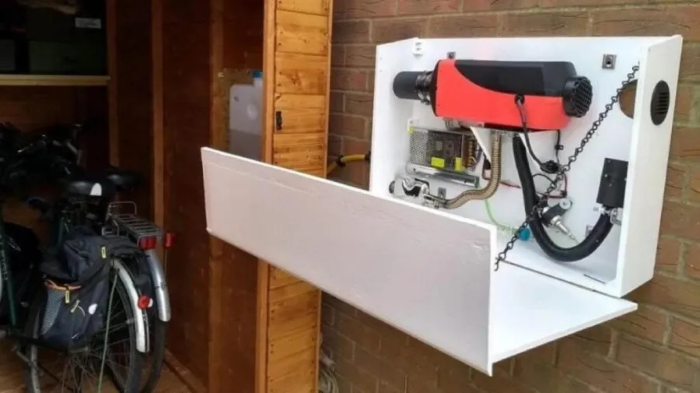
Diesel Heaters, originally designed for campervans and motorhomes, these compact units are incredibly popular in off-grid garden offices. They require some drilling through the wall for the inlet and exhaust pipes, they burn standard diesel from a small tank to produce a massive amount of dry, roaring heat.
Crucially, they only use your portable power station to run a tiny 12V internal fan and fuel pump (drawing roughly 10-40W). You get the intense heat of a 2,000W electric radiator while barely touching your battery capacity. Hourly running costs are 17p on average.
Your Off-Grid Future Awaits
Building a garden office no longer requires destroying your lawn, battling with building control, or handing over thousands of pounds to an electrician.
By calculating your exact power draw, investing in a high-quality portable power station, utilising hybrid winter charging, and keeping your heating expectations realistic, you can build a premium, entirely self-sufficient workspace.
Welcome to the plug-and-play revolution. Now, it is time for work.
Discover the best portable power stations, solar panels, and solar generators with expert comparisons, buying guides, and real-world scenario reviews.
Social
Thank You, we'll be in touch soon.
PortablePowerStations.co is a participant in the Amazon Services LLC Associates Program, an affiliate advertising program designed to provide a means for sites to earn advertising fees by advertising and linking to Amazon.com


 Garden Office Power Calculator
  #1 Choice
 #2 Choice