Boating / Marine Calculator
What Size of Power Station Do You Need For A Boat?

The Marine & Boating Power Calculator
 Marine & Boating Power Calculator
Simply enter your typical **uses**, **boils**, or **hours of runtime** for your onboard equipment below. We'll automatically determine your daily power consumption and recommend the perfect off-grid power setup for your narrowboat, yacht, or cruiser.
| Icon | Appliance | Avg. Watts | Daily Usage | Total (Wh) |
|---|---|---|---|---|
| High-Draw Galley & Comfort | ||||
| Electric Kettle (Assumes 5 mins/boil) | 1500W | boils | 0 Wh | |
| Induction Hob / Cooktop (Assumes 15 mins/use) | 1500W | uses | 0 Wh | |
| Microwave (Assumes 5 mins/use) | 1000W | uses | 0 Wh | |
| Coffee Machine / Espresso (Assumes 10 mins/use) | 1450W | uses | 0 Wh | |
| Hairdryer / Straighteners (Assumes 10 mins/use) | 1600W | uses | 0 Wh | |
| Compact Washing Machine (Assumes 1 hr per cycle) | 1000W | cycles | 0 Wh | |
| Galley Subtotal: | 0 Wh | |||
| Continuous 240V Comfort | ||||
| Fridge / Freezer (240V) (Continuous average draw) | 100W | hrs | 0 Wh | |
| CPAP / Medical Device | 40W | hrs | 0 Wh | |
| Laptop Charging | 60W | hrs | 0 Wh | |
| TV / Monitor | 50W | hrs | 0 Wh | |
| Router / Starlink | 30W | hrs | 0 Wh | |
| LED Lighting (240V) | 15W | hrs | 0 Wh | |
| 240V Comfort Subtotal: | 0 Wh | |||
| Essential 12V / 24V DC System | ||||
| Navigation Electronics (Chartplotter, AIS, VHF) | 20W | hrs | 0 Wh | |
| Autopilot | 50W | hrs | 0 Wh | |
| Bilge Pumps (Active running time) | 50W | hrs | 0 Wh | |
| Diesel Heater (Webasto / Eberspächer) | 30W | hrs | 0 Wh | |
| 12V Compressor Fridge | 30W | hrs | 0 Wh | |
| Cabin Fans | 10W | hrs | 0 Wh | |
| LED Cabin Lighting | 15W | hrs | 0 Wh | |
| Phone / Tablet Charging | 15W | hrs | 0 Wh | |
| Water Heater / Immersion | 200W | hrs | 0 Wh | |
| 12V/24V DC Subtotal: | 0 Wh | |||
| High-Surge Marine Equipment | ||||
| Anchor Windlass (Assumes 5 mins/use) | 700W | uses | 0 Wh | |
| Bow Thruster (Assumes 2 mins/use) | 1500W | uses | 0 Wh | |
| Electric Winches (Assumes 5 mins/use) | 1000W | uses | 0 Wh | |
| Fresh Water Pump (Assumes 2 mins/use) | 25W | uses | 0 Wh | |
| High-Surge Subtotal: | 0 Wh | |||
RESULTS BOX
*Calculation includes a 15% buffer to account for common 240V AC inverter efficiency loss (the standard difference between battery capacity and usable output for plug sockets).
RECOMMENDED POWER STATIONS (STEP 2)
Based on your onboard calculation above, we recommend these marine-ready choices:
Tier 1: The Weekender & Day Cruiser (Up to 1000Wh Class)
The Goal
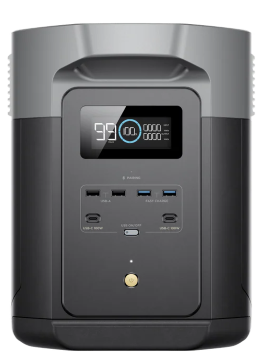
 #1 Choice: EcoFlow DELTA 2 (1,024Wh)
- Continuous Output: 1,800W pure sine wave (2,700W X-Boost)
- Main features: This is a reliable choice for use on board. It can handle microwaves and laptop charging, and it recharges quickly from shore power at the marina—going from 0 to 80% in just 50 minutes.
- With Marine Advantage, you can add an extra battery later if you decide to spend more nights away from the pontoon.
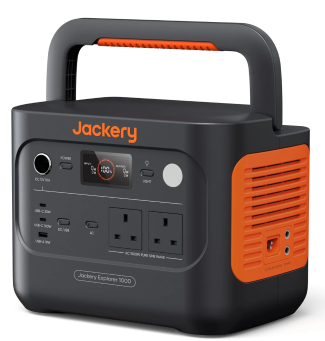
 #2 Choice: Jackery Explorer 1000 v2 (1,070Wh)
- Continuous Output: 1,500W pure sine wave (3,000W Surge)
- Features: It’s compact, sturdy, and great for weekends on a narrowboat or for keeping your essential communication gear charged.
- Marine Advantage: Its small size makes it easy to carry ashore or move between boats, and its tough casing is built for life at sea.
Technical Comparison: EcoFlow DELTA 2 vs Jackery Explorer 1000 v2
| Feature | EcoFlow Delta 2 | Jackery Explorer 1000 v2 |
|---|---|---|
| Battery Capacity | 1,024Wh (Expandable) | 1,070Wh |
| Battery Chemistry | LiFePO4 (3,000+ cycles) | LiFePO4 (4,000+ cycles) |
| Continuous AC Output | 1,800W (2,700W X-Boost) | 1,500W (3,000W Surge) |
| UK AC Outlets | 4x 230V 3-pin UK Sockets | 2x 230V 3-pin UK Sockets |
| Travel Kettle Compatible? | Yes (Handles up to 1800W–2400W) | Yes (Handles up to 1500W) |
| AC Recharge Time | 0–80% in 50 min, 100% in 80 min | ~1 Hour (Emergency Mode) |
| Max Solar Input | 500W (11–60V, 15A) | 400W |
| Weight | 12.0 kg | 10.8 kg |
| Warranty | 5 Years | 5 Years |
Once you know your daily power use from the calculator, check out our Solar Panel Selector.
Pick your power station model from the drop down list to see which solar panels fit, and which adapter cables and accessories you’ll need.
Tier 2: The Extended Liveaboard & Coastal Cruiser (1000Wh to 2000Wh+ Class)
The Goal
#1 Choice: Bluetti AC200L (2,048Wh)
- Continuous Output: 2,400W pure sine wave (3,600W Power Lifting)
- Feature: It has excellent surge capacity for marine use and can easily handle the high current needed to start appliances like induction hobs, heavy pumps, or coffee machines.
- Marine Advantage: Its sturdy, industrial build stands up to constant movement and vibration on board. It can take in up to 1,200W from solar panels, so you can stay self-sufficient while anchored.
- When paired with the Bluetti DC Hub you will be able to run multiple 12v appliances simultaneously.

#2 Choice: EcoFlow DELTA 2 Max (2,048Wh)
- Continuous Output: 2,400W pure sine wave (3,400W X-Boost)
- This unit is ideal for longer liveaboard trips and has plenty of expandable capacity for running your 12V fridge, plus multiple 230V appliances.
- Marine Advantage: The system has two MPPT solar charging ports, so you can connect both a fixed panel on the roof or cabin top and a portable folding array. This lets you make the most of weak morning or evening sunlight.
Technical Comparison: Bluetti AC200L vs EcoFlow DELTA 2 Max
| Feature | Bluetti AC200L | EcoFlow DELTA 2 Max |
|---|---|---|
| Battery Capacity | 2,048Wh (Expandable to 8kWh) | 2,048Wh (Expandable to 6kWh) |
| Battery Chemistry | LiFePO4 (3,000+ cycles) | LiFePO4 (3,000+ cycles) |
| Continuous AC Output | 2,400W (3,600W Surge) | 2,400W (3,400W X-Boost) |
| UK AC Outlets | 4 x 230V 3-pin UK Sockets | 4 x 230V 3-pin UK Sockets |
| Induction Hob & Air Fryer? | Yes (Runs simultaneously) | Yes (Handles high peak loads) |
| Max Solar Input | 1,200W (12–145V, 15A) | 1,000W (Dual MPPT Ports) |
| AC Recharge Time | ~45 min to 80%, ~1.5 hrs full | ~53 min to 80%, ~80 min full |
| Weight | 28.3 kg | 23.0 kg |
| Warranty | 5 Years | 5 Years |
Once you know your daily power use from the calculator, check out our Solar Panel Selector.
Pick your power station model from the drop down list to see which solar panels fit, and which adapter cables and accessories you’ll need.
Tier 3: The Off-Grid Yacht & Heavy Liveaboard (2000Wh+ Class)
The Goal
#1 Choice: Bluetti Apex 300 & DC Hub
- Continuous Output: 3,000W pure sine wave (6,000W Surge)
- Features: This is one of the best systems for sailing and cruising fully off the grid. It connects easily to heavy-duty 12V or 24V marine DC arrays using its special DC Hub.
- Marine Advantage: The modular design lets you separate the heavy battery storage from the inverter, making it easier to install in boat lockers and spread out the weight.

#2 Choice: EcoFlow Delta Pro 3 (4,096Wh)
- Continuous Output: 4,000W continuous (8,000W Surge)
- Feature: This is a true replacement for a diesel generator. It can run everything from washing machines to bow thrusters, and it does so without noise, vibration, or exhaust fumes.
- Marine Advantage: It starts with a 4,096Wh capacity, which you can expand to over 12kWh. When plugged into shore power at a marina or a large 2,600W solar array, it charges very quickly.

Technical Comparison: Bluetti Apex 300 vs EcoFlow Delta Pro 3
| Feature | Bluetti Apex 300 & DC Hub | EcoFlow Delta Pro 3 |
|---|---|---|
| Base Capacity | 3,072Wh (Modular B300) | 4,096Wh |
| Max Expanded Capacity | Up to 12,288Wh | Up to 12,288Wh |
| Battery Chemistry | LiFePO4 (3,500+ cycles) | LiFePO4 (4,000+ cycles) |
| Continuous AC Output | 3,000W (6,000W Surge) | 4,000W (8,000W Surge) |
| UK AC Outlets | 4 x 230V 3-pin UK Sockets | 4 x 230V 3-pin UK Sockets |
| Heavy Marine Equipment | Winches, Immersion Heaters | Bow Thrusters, Washers, Hobs |
| Max Solar Input | 2,400W (Dual MPPT) | 2,600W (Dual MPPT Ports) |
| Shore Power / Fast Charge | Rapid AC Charging | High-Speed Shore Power Sync |
| Warranty | 4 Years | 5 Years |
Complete Your Marine Solar Setup
Clean, Silent Marine Power
You no longer have to deal with a noisy, smoky generator or worry about draining your engine starter battery while moored.
By choosing a portable power station that matches your boat’s electrical needs, you can sail confidently, knowing your navigation equipment, fridge, and galley appliances will always have power.
