Small Workshop Power Calculator
What Size Of Power Station Do You Need For A Small Workshop?
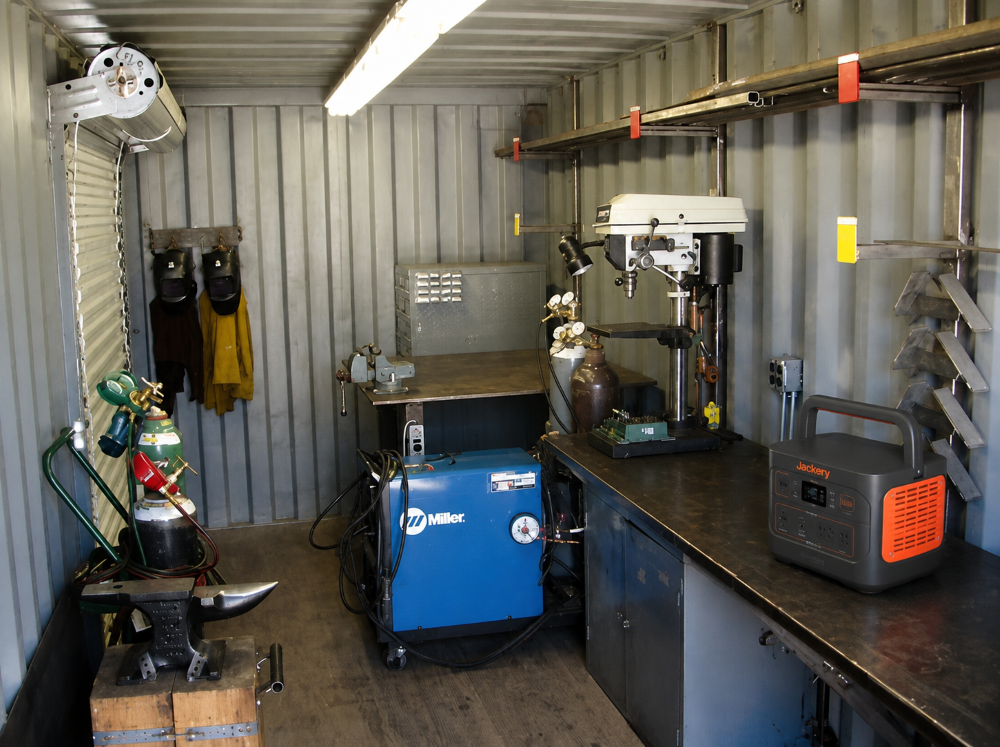
The Small Workshop Power Calculator
 Small Workshop Power Calculator
Enter your typical **uses** or **hours of runtime** for your power tools and workshop gear below. We'll automatically calculate your daily consumption and recommend the perfect heavy-duty power station to handle those massive power surges off-grid.
| Icon | Appliance | Avg. Watts | Daily Usage | Total (Wh) |
|---|---|---|---|---|
| High-Draw Power Tools | ||||
| Table Saw / Circular Saw (Assumes 5 mins total cut time/use) | 1700W | uses | 0 Wh | |
| Mitre Saw / Chop Saw (Assumes 5 mins total cut time/use) | 1600W | uses | 0 Wh | |
| Corded Drill / Impact Driver (Assumes 10 mins active use) | 900W | uses | 0 Wh | |
| Angle Grinder (Assumes 5 mins/use) | 1500W | uses | 0 Wh | |
| Orbital / Random Orbit Sander (Assumes 15 mins/use) | 350W | uses | 0 Wh | |
| Belt Sander / Disc Sander (Assumes 10 mins/use) | 1100W | uses | 0 Wh | |
| Heat Gun (Assumes 10 mins/use) | 1800W | uses | 0 Wh | |
| Router (Assumes 10 mins/use) | 1200W | uses | 0 Wh | |
| Planer / Thicknesser (Assumes 10 mins/use) | 1550W | uses | 0 Wh | |
| Jigsaw (Assumes 10 mins/use) | 600W | uses | 0 Wh | |
| Reciprocating Saw (Assumes 5 mins/use) | 800W | uses | 0 Wh | |
| Power Tools Subtotal: | 0 Wh | |||
| Air & High-Surge Equipment | ||||
| Air Compressor (Small/Med) (Assumes 15 mins/use) | 2000W | uses | 0 Wh | |
| Impact Wrench (Assumes 5 mins/use) | 500W | uses | 0 Wh | |
| Nail Gun / Stapler (With compressor - Assumes 10 mins/use) | 1000W | uses | 0 Wh | |
| Air Equipment Subtotal: | 0 Wh | |||
| Continuous / Workshop Support | ||||
| Shop Vac / Dust Extractor (Hours connected to tools) | 1250W | hrs | 0 Wh | |
| Cordless Tool Battery Chargers | 120W | hrs | 0 Wh | |
| LED Workshop Room Lighting | 50W | hrs | 0 Wh | |
| Workbench LED / Task Light | 30W | hrs | 0 Wh | |
| Radio / Bluetooth Speaker | 20W | hrs | 0 Wh | |
| Phone / Tablet Charging | 15W | hrs | 0 Wh | |
| Laptop Charging | 60W | hrs | 0 Wh | |
| Fan / Heater (small) | 1000W | hrs | 0 Wh | |
| Support Subtotal: | 0 Wh | |||
| Welding & Heavy Equipment (Optional) | ||||
| MIG / Arc Welder (small) (Assumes 10 mins active welding) | 2500W | uses | 0 Wh | |
| Plasma Cutter (Assumes 10 mins active cutting) | 3500W | uses | 0 Wh | |
| Heavy Equipment Subtotal: | 0 Wh | |||
RESULTS BOX
*Calculation includes a 15% buffer to account for common 240V AC inverter efficiency loss (the standard difference between battery capacity and usable output for heavy-duty plug sockets). Note: Ensure your chosen power station's AC output rating exceeds your highest wattage tool!
RECOMMENDED POWER STATIONS (STEP 2)
Based on your off-grid workshop calculation above, we recommend these heavy-duty choices:
Tier 1: The Mobile Tool & Charging Station (Up to 1000Wh Class)
The Goal
 #1 Choice: EcoFlow River 2 Pro
- Continuous Output: 800W pure sine wave (1,600W X-Boost)
- Highlights: This model is lightweight and easy to carry. It is great for running battery chargers, lights, and site radios without any hassle.
- Workshop Advantage: It recharges from empty to full in just 70 minutes with a regular mains socket. You can top it up during your lunch break before going back to work.

 #2 Choice: Anker Solix C800
- Continuous Output: 1,200W pure sine wave (2,400W SurgePad)
- Highlights: This tough, compact unit has built-in lighting and is ideal for keeping smaller tools and devices running all day.
- Workshop Advantage: With a strong 1,200W continuous output, this unit stands out for its size. It can run small corded routers or sanders that might overload an 800W inverter.
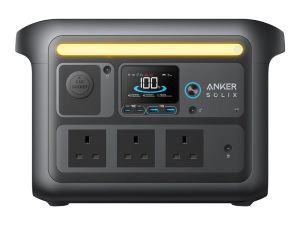
Technical Comparison: EcoFlow River 2 Pro vs Anker Solix C800
| Feature | EcoFlow River 2 Pro | Anker Solix C800 |
|---|---|---|
| Battery Capacity | 768Wh | 768Wh |
| Battery Chemistry | LiFePO4 (3,000+ cycles) | LiFePO4 (3,000+ cycles) |
| Continuous AC Output | 800W (1,600W X-Boost) | 1,200W (2,400W SurgePad) |
| UK AC Outlets | 3x 230V 3-pin UK Sockets | 3x 230V 3-pin UK Sockets |
| AC Mains Recharge | 70 Minutes (0–100%) | 58 Minutes (0–80%) |
| Max Solar Input | 220W (11–50V, 13A) | 300W |
| Weight | 7.8 kg | ~10.9 kg |
| Warranty | 5 Years | 5 Years |
If you work out of a van, or a small workshop use our Solar Panel Selector to find the right flexible or folding solar panels for these portable units.
Pick your power station model from the drop down list to see which solar panels fit, and which adapter cables and accessories you’ll need.
Tier 2: The Serious DIY & Corded Tool Workshop (1000Wh + Class)
The Goal
#1 Choice: Bluetti AC200L
- Continuous Output: 2,400W pure sine wave (3,600W Power Lifting)
- Highlights: This heavy-duty power station easily handles the high surge power needed for chop saws, angle grinders, and air compressors.
- Workshop Advantage: Its tough build can handle dusty workshops. With 2,400W continuous output, you can run a small 1,500W table saw and a 700W shop vac together.

#2 Choice: EcoFlow DELTA 2 Max
- Continuous Output: 2,400W pure sine wave (3,400W X-Boost)
- Highlights: This unit has a large capacity for all-day workshop use. It can run dust extractors and power tools at the same time without any trouble.
- Workshop Advantage: It charges very quickly, even from two sources at once. You can keep it plugged into a 1,000W solar array on your workshop roof while you work, so the 2,048Wh battery stays topped up as you use it.
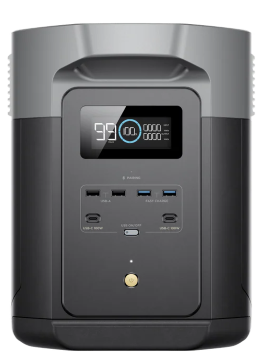
Technical Comparison: Bluetti AC200L vs EcoFlow DELTA 2 Max
| Feature | Bluetti AC200L | EcoFlow DELTA 2 Max |
|---|---|---|
| Battery Capacity | 2,048Wh (Expandable to 8kWh) | 2,048Wh (Expandable to 6kWh) |
| Battery Chemistry | LiFePO4 (3,000+ cycles) | LiFePO4 (3,000+ cycles) |
| Continuous AC Output | 2,400W (3,600W Surge) | 2,400W (3,400W X-Boost) |
| UK AC Outlets | 4 x 230V 3-pin UK Sockets | 4 x 230V 3-pin UK Sockets |
| Air compressor & Impact Wrench? | Yes (Runs simultaneously) | Yes (Handles high peak loads) |
| Max Solar Input | 1,200W (12–145V, 15A) | 1,000W (Dual MPPT Ports) |
| AC Recharge Time | ~45 min to 80%, ~1.5 hrs full | ~53 min to 80%, ~80 min full |
| Weight | 28.3 kg | 23.0 kg |
| Warranty | 5 Years | 5 Years |
Use our Solar Panel Selector to see which solar panels and accessories you will need to power a 2kWh portable power station off grid, whether you are you using foldable or fixed roof solar panels.
Just enter your chosen power station in the drop-down list for a custom built solar panel and accessories list with multiple options.
The Goal
You run an off-grid workshop, an agricultural shed, or a heavy-duty fabrication shop. You need real 230V generator-level power for heavy-duty equipment like table saws, thickness planers, and heavy duty dust extractors that run constantly.
These units feature 3,000W to 4,000W pure-sine-wave inverters. They are designed to serve as the primary electrical backbone of an entire building, with modular battery expansion that lets you scale your power reserves up to 12kWh.
#1 Choice: Bluetti Apex 300
- Continuous Output: 3,000W pure sine wave (6,000W Surge)
- Highlights: This is the top choice for off-grid workshop power. You can run heavy equipment and large loads as if you were connected to the mains.
- Workshop Advantage: This system is fully modular. The inverter is separate from the battery modules, so you can install it under a workbench for ease of use.

#2 Choice: EcoFlow Delta Pro 3
- Continuous Output: 4,000W continuous (8,000W Surge)
- Highlights: This is a real 240V generator replacement. It can power a whole heavy-duty workshop off-grid, with no noise and no fumes.
- Workshop Advantage: With 4,000W continuous output, even tough, high-surge industrial motors will start and run smoothly without slowing down the system.

Technical Comparison: Bluetti Apex 300 vs EcoFlow Delta Pro 3
| Feature | Bluetti Apex 300 & DC Hub | EcoFlow Delta Pro 3 |
|---|---|---|
| Base Capacity | 3,072Wh (Modular B300) | 4,096Wh |
| Max Expanded Capacity | Up to 12,288Wh | Up to 12,288Wh |
| Battery Chemistry | LiFePO4 (3,500+ cycles) | LiFePO4 (4,000+ cycles) |
| Continuous AC Output | 3,000W (6,000W Surge) | 4,000W (8,000W Surge) |
| UK AC Outlets | 4 x 230V 3-pin UK Sockets | 4 x 230V 3-pin UK Sockets |
| App Control | Yes | Yes |
| Max Solar Input | 2,400W (Dual MPPT) | 2,600W (Dual MPPT Ports) |
| Shore Power / Fast Charge | Rapid AC Charging | High-Speed Shore Power Sync |
| Warranty | 5 Years | 5 Years |
Power Your Workshop with Solar
Clean, Silent Workshop Power
You no longer have to deal with exhaust fumes or loud petrol generators to use power tools off-grid.
Choose a portable power station that matches your tools' surge wattage for instant, reliable 230V power wherever you work.
