Jackery SolarSaga 100W vs Renogy 100W Solar Panels
By: Jonny Graham | Updated April 2026 | 7 min read time
You’re shopping for a portable 100W solar panel to charge your power station while camping, van-living, or backpacking. Both the Jackery SolarSaga and the Renogy deliver the same rated power, yet one costs around £100 more.
The Jackery SolarSaga and the Renogy 100W solar panels both charge your power station while you’re out and about. However, they differ in terms of price, durability, and ease of use.
In this guide, we will break down the differences to help you decide if the premium Jackery SolarSaga is worth the extra money – or if the more affordable Renogy does the job just as well.
Quick Verdict:
In short:
Choose the Jackery SolarSaga 100W if you want plug-and-play simplicity, excellent portability, and a panel that feels premium and durable for frequent moving.
Choose the Renogy 100W if you want to save around £100 and don’t mind using a simple adapter to your power station.
Note: If you’re planning a permanent or semi-permanent setup with rigid panels on your van roof, Renogy’s monocrystalline panels are the best option. (But that’s for a separate comparison, though.)
What Do the Panels Actually Do?:
Both are portable foldable 100W panels, which means:
• They fold down easily for backpack or vehicle storage.
• Set up in 2-5 minutes at a campsite with built-in kickstands
• Charge a 300 Wh power station from 0-100% in ~4-6hrs hours (in good conditions)
• Let you top up your power station daily while parked off-grid.
• Allow you to reposition them throughout the day to catch the sun.
The real difference isn’t in charging times. It’s more about build quality, price, and ease of setup.
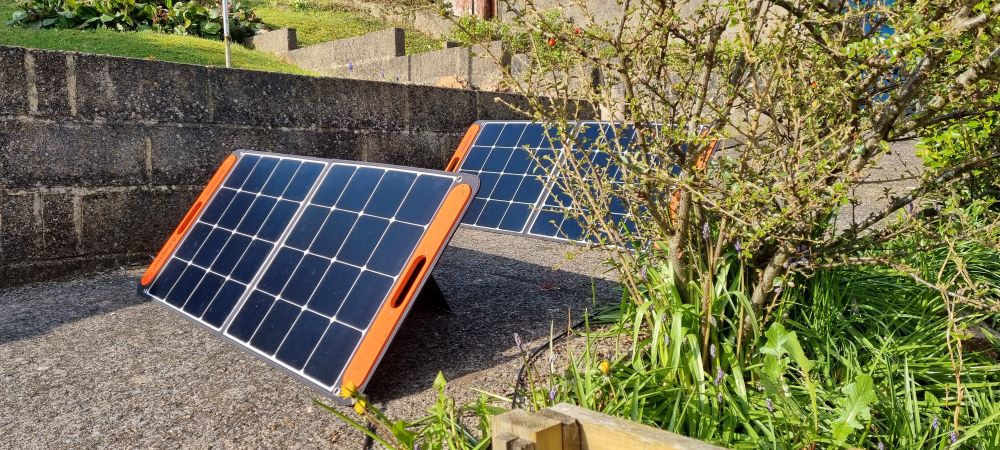
Now, let’s have a side-by-side look at the Jackery Solar-Saga 100W versus the Renogy Eflex-Core 100W. This table highlights the practical differences that matter most when you’re camping, van-living or backpacking.
| Feature | Jackery SolarSaga | Renogy 100W EFLEX-CORE | Winner |
| Weight | 4.6 kg | 3.3 kg | Renogy (noticebly lighter) |
| Dimensions (unfolded) | 121.9 x 53.3 x 0.5 cm Briefcase size | 114.5 x 58.4 x 0.3 cm Almost the same size | Draw |
| Setup time | 2 minutes (plug and play) | 3 minutes (adapter + cables) | Jackery |
| Waterproof rating | IP68 (heavy rain safe) | IP65 (splash spray safe) | Jackery |
| Fits directly to power station? | Yes (no adapter needed) | No (needs MC4-DC8020 adapter) | Jackery |
| Price (approx) | £199 | £99.99 | Renogy (£100 saving) |
| Durability in van (bouncing around) | Excellent (sealed design) | Good (more flexible but potentially fragile) | Jackery |
Key takeaway: The Jackery wins on convenience, weather resistance, and seamless integration. The Renogy shines if weight and Budget are your top priorities.
If you’re new to solar, affordable aftermarket panels like the Renogy are one of the cheapest ways to test the waters without a big upfront commitment. You can try portable solar at low cost – and if it doesn’t work for your lifestyle, you’re not out by much. On the other hand, if you know you will be using solar regularly and don’t want any hassle, Jackery is worth it for its ease of use and better build quality, making it a good long-term choice.
Use Case:
Hybrid Setup (Portable + Fixed Roof)
If you have room for both portable and rigid panels.
| Component | Best Choice | Why |
| Portable 100-200W panel | Jackery SolarSaga | easier to move around the campsite, reposition to catch the sun. |
| Fixed roof panel (200W) | Renogy monocrystalline rigid panel | The Market-leading rigid panels for permanent mounting, durability in all weathers |
| Why combine them? | — | Portable panels give you flexibility on travel days: rigid roof panels provide consistent charging while driving or parked |
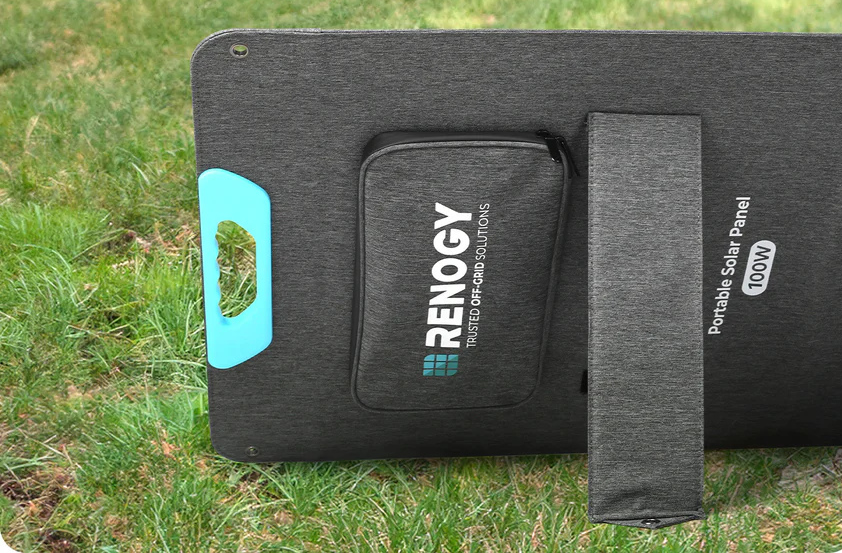
Combining portable panels with roof-mounted solar means you can park your van in the shade on hot days while still charging in full sun. Your roof panels keep things ticking over while you’re driving or away from the van. This hybrid approach lets you chase the sun without hassle.
The Tech Details:
Weight:
- Renogy 100W EFLEX-CORE: Approximately 3.3 kg
- Jackery SolarSaga 100W: Approximately 4.6 kg.
The Renogy wins if you frequently backpack with the panel – every gram counts.
Waterproofing:
• Jackery: IP68 (submersion-safe in theory, excellent for heavy rain).
• Renogy: IP65 (splash and spray safe).
Both handle typical UK weather well. Jackery’s higher rating gives extra peace of mind if you get caught in a sudden downpour.
Adapters & Compatibility:
• Jackery: The SolarSaga 100W panel plugs directly into most Jackery power stations – genuinely plug and play with no extra cables needed.
• Renogy: Uses standard MC4 connectors, so you’ll need an MC4 to DC8020 (8mm) adapter to connect to Jackery units.
This is one of the most common annoyances with solar setups, brands like Jackery, Bluetti and EcoFlow all use different connectors.
If you are mixing panels and power stations, it’s worth budgeting around £15- £20 for a decent adapter.
Efficiency:
Both panels are rated at 100W nominal with real-world, output around ~80-90W range under good sunlight and angle placement.
Verdict: It’s essentially a tie. In practice, charging times for your power station from both panels will be the same.
Warranty:
Both the Jackery and Renogy offer a standard manufacturer’s warranty of around 2 – 5 years on materials and workmanship (often extendable with registration).
Verdict: Another close tie – neither stands out significantly here.
Which One Should You Pick?
Pick Jackery SolarSaga 100W if:
• You move your panel frequently (van life, daily repositioning)
• You want absolutely zero setup hassle with adapters or extra cables
• You value a durable, lightweight, compact panel that feels premium
• You already own a Jackery power station and want seamless integration
• You’re happy to invest a bit more for convenience and long-term peace of mind

Jackery SolarSaga 100W
The perfect fit. Waterproof, durable,
No adaptors needed
Pick Renogy 100W if:
• You want to save around £100 and get excellent value for money
• You’re testing solar for the first time, or you are on a tighter budget.
• You don’t mind using a simple, inexpensive MC4 adapter for your power station

Renogy 100W EFLEX-CORE
Lightweight Solid Performance
Requires An Adapter
Less Than Half The Price Of The Jackery
Ready to charge with solar?
→ Check our How to Connect Solar Panels Guide — learn safe installation and setup tips.
→ Not sure how much solar you need?
Use our Solar Panel Calculator to size the perfect setup for your van, camping trips or off-grid needs. Just enter your power station details in the dropdown list.
Recommended Accessory
For both the Jackery SolarSaga and Renogy 100W panels, we highly recommend adding a 3m MC4 Solar Extension Cable. It lets you position your power station safely in your van or in the shade while the panel sits in full sun, maximising charging without compromising safety.
FAQ:
Can I use a Renogy panel with my Jackery power station?
Yes, it works well. You’ll need an MC4-to-DC8020 adapter cable (£15-20). Check your power station’s input port or user manual first.
Which one survives getting rained on?
Both panels can handle typical UK weather without any problems. The Jackery’s IP68 rating is more than you’ll need for portable use; the Renogy’s IP65 (splash proof) rating is perfectly adequate for most users.
Which one is easier for a beginner?
The Jackery SolarSaga 100W is noticeably easier for beginners. No adapters required – just unfold, position, and connect directly to your Jackery power station. The Renogy works well too, but you’ll need a simple MC4-to-DC8020 adapter, which adds one extra step (plus a small extra cost).
Can I expand later (add a second panel)?
Yes, use our Solar Panel Calculator to see exactly how much you can add to your current setup to increase your power – whether you are camping or building a hybrid system.
Which one charges faster?
There is no noticeable difference between the Jackery SolarSaga and the Renogy 100W, which deliver a very similar output (typically 80 – 90W) in good sunlight.

